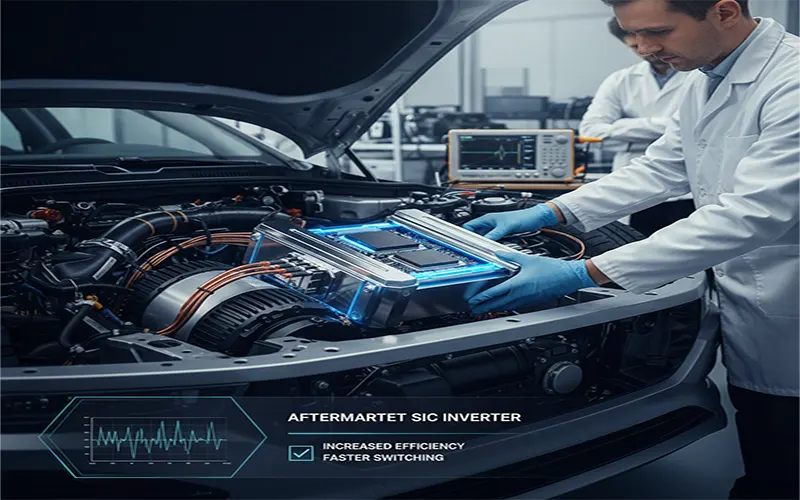
In the early years of the electric vehicle transition, performance was a product of software limits and battery cell discharge rates. However, as we enter 2026, the enthusiast community has identified a new mechanical ceiling: the silicon-based inverter. For owners of aging 400V platforms (2018–2022) or those building custom high-output drivetrains, the transition to Silicon Carbide (SiC) MOSFET-based inverters is the equivalent of a “turbo swap” for the digital age.
By replacing traditional Silicon (Si) Insulated-Gate Bipolar Transistors (IGBTs) with SiC power modules, tuners are unlocking higher efficiencies, reduced thermal bottlenecks, and a significant expansion of the motor’s usable power band.
1. Beyond the IGBT Limit: The Wide Bandgap Advantage
For decades, the standard for power conversion has been the Silicon IGBT. While robust, these transistors suffer from a fundamental physical limitation: switching losses. Because silicon has a relatively narrow bandgap, it requires significant energy to “turn on” and “turn off,” and it generates a “tail current” during deactivation that bleeds energy as waste heat.
Silicon Carbide is a Wide Bandgap (WBG) semiconductor. Its crystal structure allows for a critical electric field that is nearly 10 times higher than pure silicon.
- Switching Frequency: While standard IGBT inverters typically operate at frequencies between 8 kHz and 16 kHz, SiC modules can comfortably switch at over 100 kHz.
- Loss Reduction: Faster switching means the transition time—the period where the transistor is neither fully on nor fully off—is drastically reduced. This cuts energy losses during the DC-to-AC conversion by up to 70%.
2. Efficiency Gains: Range and Partial Load Recovery
In an EV, the inverter is the “translator” between the battery’s DC and the motor’s AC. Most highway driving occurs at “partial load,” where the motor requires only a fraction of its peak power. Silicon inverters are notoriously inefficient at these lower loads.
Upgrading to an aftermarket SiC module (like those being developed for the Tesla Model 3 or Hyundai E-GMP platforms in the 2026 secondary market) can improve overall powertrain efficiency by 5% to 10%.
$$\text{Efficiency Recovery} = \eta_{\text{SiC}} – \eta_{\text{Si}} \approx 3\text{–}5\% \text{ (Total Vehicle Level)}$$
For a vehicle with a 300-mile range, a high-frequency SiC swap can effectively “find” an extra 15 miles of highway range without adding a single battery cell.
3. Thermal Management and Power Density
One of the greatest enemies of EV performance is Heat Soak. When an inverter gets too hot, the Battery Management System (BMS) pulls back power to protect the electronics.
SiC has 3x higher thermal conductivity than silicon. Because the SiC MOSFETs generate significantly less waste heat (due to those lower switching losses), the entire inverter package can be smaller and lighter. In 2026, we are seeing “drop-in” SiC modules that fit inside factory housings but can handle 30% higher current without triggering thermal derating. This allows for sustained full-throttle pulls that would have overheated a factory 2020-era inverter in seconds.
4. The “High-Frequency” Benefit for High-RPM Motors
Faster switching doesn’t just save energy; it allows for more precise control of the motor’s magnetic field. At high RPMs, the “sine wave” created by the inverter becomes choppy on low-frequency IGBT systems. This creates Harmonic Losses, where the motor begins to fight against itself.
By upgrading to a high-frequency SiC inverter, the AC wave remains smooth even as the motor spins toward 20,000 RPM. This reduces internal motor heat and effectively raises the “top-end” torque curve, providing a noticeable boost in power at speeds above 80 mph.
5. Installation and EMI Challenges: The Tech’s Trade-off
The performance of SiC is not free; it requires a higher level of electrical “hygiene.”
- dv/dt Stress: Because SiC switches so fast, it creates a very high “voltage slew rate” ($dv/dt$). This can create Reflected Wave Phenomena, where voltage spikes at the motor terminals can be double the bus voltage, potentially damaging the motor’s internal winding insulation.
- EMI Interference: High-frequency switching creates Electromagnetic Interference (EMI). An aftermarket SiC swap requires upgraded, high-grade shielded HV cables and robust “Gate Drivers” (like the GD3162 or similar 2026-spec drivers) to ensure the signals stay clean.
6. The 2026 Market Outlook
As we move through 2026, brands like Wolfspeed, Infineon, and specialized tuners are offering 800V-capable SiC power blocks for 400V vehicles. While the hardware cost remains higher than traditional silicon, the “system-level” benefit—smaller radiators, lighter cabling, and increased range—makes SiC the definitive choice for the next generation of high-performance EV builds.
Comparison: Si IGBT vs. SiC MOSFET (2026 Standards)
| Feature | Silicon IGBT | SiC MOSFET |
| Max Switching Freq | ~20 kHz | >100 kHz |
| Switching Losses | High (Tail Currents) | Ultra-Low |
| Operating Temp | Up to 150°C | Up to 200°C |
| System Efficiency | 94–96% | 98.5–99.2% |
| Cost (per Module) | $ | $$$ |