
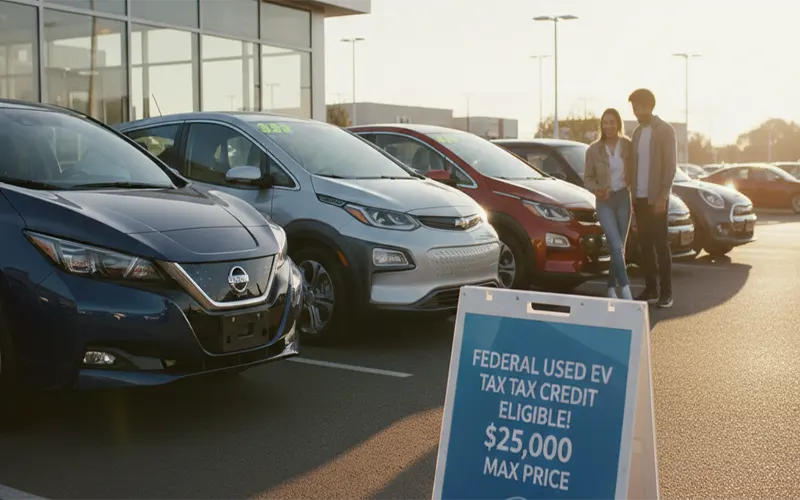
The year 2026 has become a “perfect storm” for savvy electric vehicle buyers. A massive wave of 2023 and 2024 lease returns is currently flooding dealership lots, driving prices to historic lows. Simultaneously, the federal government’s Used Clean Vehicle Credit (IRC 25E) remains a powerful tool, offering an immediate “point-of-sale” discount of up to $4,000.
If you are looking to transition to electric for less than the cost of a new base-model Corolla, here is how to navigate the 2026 market and which cars offer the best bang for your buck.
1. The 2026 Tax Credit Landscape: What You Need to Know
In 2026, the federal used EV tax credit is no longer a “wait until April” tax break. It is an instant rebate. Most participating dealers now allow you to transfer the credit directly to them, lowering your “out-the-door” price at the moment of purchase.
Key Eligibility Rules:
- The $25,000 Cap: The sale price must be $25,000 or less. This includes dealer fees but excludes taxes and registration.
- The 2-Year Rule: The car must be at least two model years old. For a 2026 purchase, the vehicle must be a 2024 model or older.
- Income Limits: Your modified adjusted gross income (MAGI) must be below $75,000 (Single), $112,500 (Head of Household), or $150,000 (Joint).
- The Dealer Requirement: You must buy from a licensed dealer; private party sales do not qualify for the credit.
2. Top Pick #1: The 2023 Tesla Model 3 (Standard Range)
For the first time, 2023 Tesla Model 3s are consistently dipping below the $25,000 threshold. These are primarily lease returns from the massive 2023 sales push.
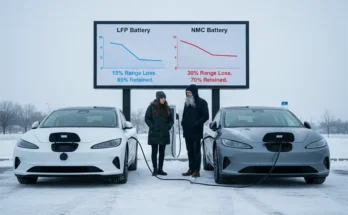
Why it’s a winner: The 2023 RWD Model 3 features the Lithium Iron Phosphate (LFP) battery. Unlike earlier Teslas, these batteries can be charged to 100% daily with minimal degradation. You get access to the unrivaled Supercharger network and a car that likely still has 5+ years of battery warranty remaining.
3. Top Pick #2: The 2022-2023 Chevrolet Bolt EUV
The Bolt EUV was discontinued in late 2023, making it a prime target for used buyers in 2026. Because it was priced affordably when new, finding one under $25,000 is easy—and many are selling for closer to $18,000, meaning your net price after the credit could be as low as $14,000.
Why it’s a winner:
It offers 247 miles of range and a surprisingly spacious back seat. While its DC fast-charging speed is slow compared to a Tesla (capped at 55 kW), it is the most cost-effective “all-arounder” for families who do most of their charging at home.
4. Top Pick #3: The 2022 Hyundai IONIQ 5 (SE Trim)
In early 2026, the first wave of 2022 IONIQ 5 lease returns has finally pushed the “SE” and “SEL” trims into the sub-$25,000 category.
Why it’s a winner:
The IONIQ 5 is built on an 800V architecture. This means it can charge from 10% to 80% in just 18 minutes at a 350 kW charger—nearly twice as fast as a Tesla Model 3. If you frequently take road trips, this is the most technologically advanced vehicle you can buy in this price bracket.
5. Comparison Table: 2026 Used EV Value
| Model | Typical 2026 Price | Net Price After Credit | Range (EPA) | Max Charging Speed |
| 2023 Tesla Model 3 | $23,500 | $19,500 | 272 Miles | 170 kW |
| 2023 Chevy Bolt EUV | $19,000 | $15,000 | 247 Miles | 55 kW |
| 2022 Hyundai IONIQ 5 | $24,500 | $20,500 | 220-303 Miles | 235 kW |
| 2022 Ford Mach-E | $24,000 | $20,000 | 230 Miles | 115 kW |
6. The “Hidden Gems”: VW ID.4 and Polestar 2
If you want something that feels a bit more “European,” keep an eye on these two:
- 2022 VW ID.4: These have depreciated sharply and offer a very comfortable, quiet ride. Look for the “Pro” trim to get the larger 82 kWh battery.
- 2022 Polestar 2: Originally a luxury competitor to Tesla, the Polestar 2 has high depreciation, making it a steal under $25k. It offers one of the best infotainment systems (Google Built-in) and premium interior materials.
7. Critical Checklist Before You Sign
Before you hand over your down payment, ensure you’ve checked these three 2026-specific boxes:
- VIN Eligibility: Have the dealer run the VIN through the IRS Energy Credits Online portal before you sign. This confirms the vehicle hasn’t already had a used credit claimed on it (you can only claim the credit once per vehicle “life”).
- Point-of-Sale Registration: Confirm the dealership is actually registered with the IRS to do the transfer. If they aren’t, you’ll have to wait until tax season to get your $4,000 back.
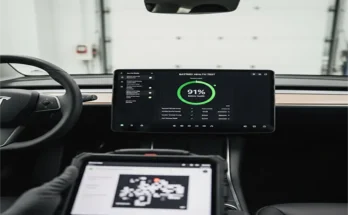
- Battery Health Report: For 2022/2023 models, ask for a “State of Health” (SOH) printout. In 2026, a healthy battery should still be above 94% capacity.
Buying a used EV in 2026 is no longer a gamble; it’s a strategic financial move. By targeting a 2023 Tesla or a 2022 IONIQ 5, you are getting modern range and tech for a “budget car” price.