The 2023 Tesla Model 3 was a benchmark year for the world’s most popular electric sedan. However, as the first wave of 12-month and 24-month lease returns hits the used market in 2026, prospective buyers face a unique challenge. Unlike a traditional internal combustion vehicle, where a high-mileage engine can be assessed by sound or oil quality, an EV’s “engine”—the battery—is a silent black box.
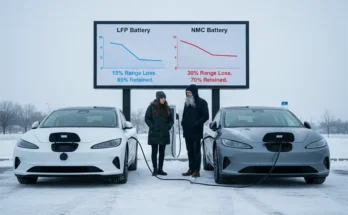
In the 2023 vintage, Tesla utilized two distinct battery chemistries: Lithium Iron Phosphate (LFP) for the Rear-Wheel Drive (RWD) models and Nickel Cobalt Aluminum (NCA) for the Long Range and Performance variants. Understanding how to verify the State of Health (SOH) of these specific packs is the difference between a savvy investment and a costly mistake.
1. The 2023 Battery Landscape
Before diving into the diagnostics, you must identify what you are testing.
- Model 3 RWD (LFP): These packs are incredibly durable and designed to be charged to 100% daily. However, they are prone to “voltage drift,” where the car’s computer loses track of exactly how much energy is left, sometimes resulting in inaccurate range displays.
- Model 3 Long Range/Performance (NCA): These packs prefer to stay between 20% and 80%. If a previous lessee consistently charged an NCA pack to 100% and let it sit in a hot garage, the SOH will reflect that chemical stress.
State of Health (SOH) is a percentage representing the current battery capacity relative to its capacity when new. A 2023 Model 3 with 20,000 miles should typically show an SOH between 96% and 98%.
2. The “Quick & Dirty” Method (Test Drive Estimate)
If you are at a dealership and only have 20 minutes, you can perform a “back-of-the-napkin” calculation.
- Switch the Display: Tap the battery icon or go to Controls > Display and change “Energy Display” from percentage to Distance.
- The Math: Note the current mileage range and the current battery percentage.
- Formula: $(\text{Current Miles} / \text{Battery \%}) \times 100 = \text{Estimated Full Range}$
- The Comparison: Compare that number to the 2023 EPA ratings:
- RWD: ~272 miles
- Long Range: ~333–358 miles (depending on wheels)
Pro Tip: If the “Estimated Full Range” is more than 10-12% below the EPA rating on a 2023 model, the battery has either significantly degraded or—more likely—the Battery Management System (BMS) needs recalibration.
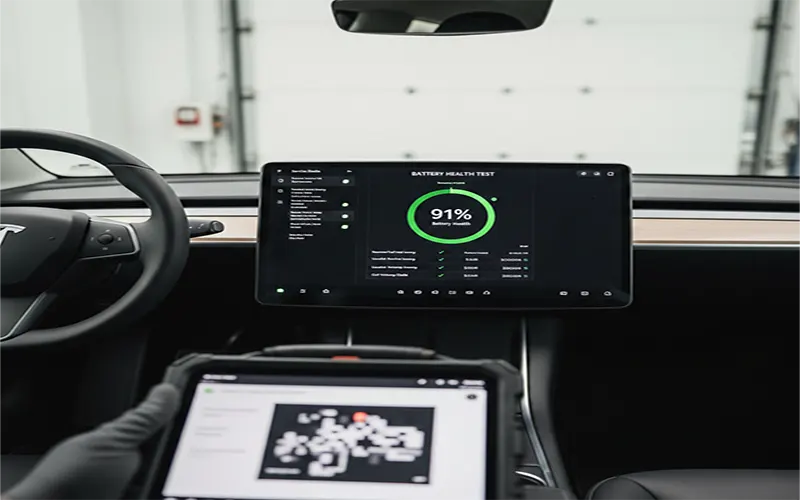
3. The Deep Dive: Tesla’s Official Battery Health Test
For a definitive answer, you need to access Tesla’s internal diagnostic suite. This used to be reserved for technicians, but it is now accessible to owners via Service Mode.
Step-by-Step Access:
- Go to Controls > Software.
- Tap and hold the “Model 3” text for 5 seconds, then release.
- A prompt will appear; type service and tap OK.
- Navigate to Service > Battery Health.
Running the Test:
The official Battery Health Test is the “Gold Standard,” but it has strict requirements:
- Low SOC: The car must be at less than 20% charge.
- Level 2 Charging: It must be plugged into an AC charger providing at least 5 kW of power.
- Time: The test can take up to 24 hours. The car will fully discharge the battery to 0% (using the internal heaters) and then slow-charge it to 100% to measure every single watt-hour.
Upon completion, the screen will display a clear percentage (e.g., 97%). This is the number Tesla uses for warranty claims.
4. The Third-Party Advantage: Tessie and Recurrent
If you cannot leave a car plugged in for 24 hours at a dealership, third-party apps are your best friend.
- Recurrent Auto: Many dealerships now provide a “Recurrent Report” for used EVs. It acts like a Carfax for batteries, showing how this specific 2023 Model 3 compares to thousands of others in their database.
- Tessie: If the seller allows you to link the car to the Tessie app, you can instantly see the Battery Health tab. It pulls the “Maximum Nominal Capacity” directly from the BMS without needing a 24-hour cycle.
- ScanMyTesla: For the hardcore enthusiast, this requires an OBD-II adapter and a wiring harness. It provides granular data, including cell imbalance and the total number of kWh charged via Superchargers vs. Home charging.
5. Understanding LFP vs. NCA Health
A common “false alarm” in 2023 RWD models is a low range reading caused by BMS drift. Because LFP batteries have a very flat discharge curve, the computer can “forget” where the top and bottom of the battery are if it isn’t charged to 100% weekly.
If a 2023 RWD shows “poor” health, ask the dealer to charge it to 100% and let it sit for an hour. Often, the range will “magically” jump up as the BMS recalibrates. NCA batteries (Long Range) do not suffer from this as much but are more physically sensitive to being left at 100%.
6. Red Flags to Watch For
Beyond the SOH percentage, look for these warning signs in the Service Mode Alerts:
- BMS_a066 / BMS_a067: These indicate internal isolation or cell voltage issues.
- Thermal Alerts: If the car shows history of “Coolant flow restricted,” the battery may have been subjected to excessive heat during Supercharging.
- Rapid Percentage Drops: If the battery drops from 10% to 0% in a matter of seconds during your test drive, a cell module may be failing.
7. The 2023 Buyer’s Checklist
When inspecting a 2023 lease return, follow this hierarchy:
| Step | Action | Ideal Result |
| 1 | Check Service Mode Alerts | No “BMS” or “VCFRONT” alerts |
| 2 | Compare Rated Range | Within 5% of original EPA miles |
| 3 | Check Charging History | Primarily Home/AC charging (visible in “Energy” app) |
| 4 | Verify Warranty | Ensure ~6 years and >80k miles of battery warranty remain |
A 2023 Tesla Model 3 is generally a safe bet. With the LFP chemistry in the RWD models, you are looking at a battery designed to last 300,000+ miles. By using Service Mode and verifying the SOH, you can buy with the confidence that your “new-to-you” Tesla has plenty of life left in its cells.