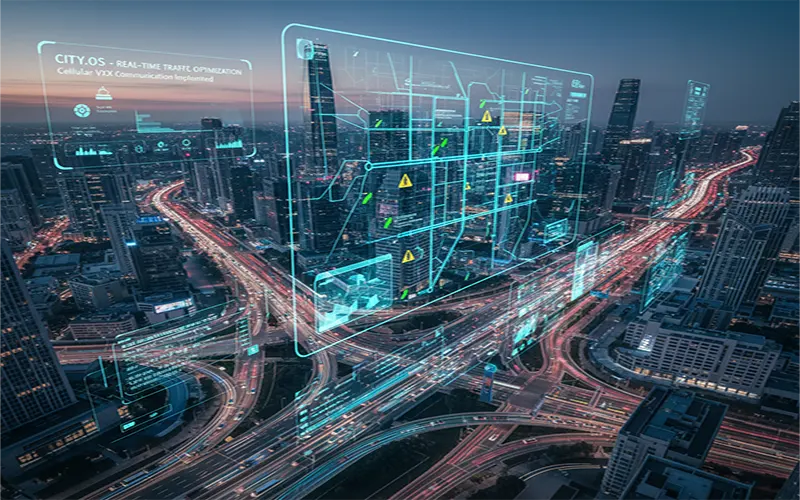
The dream of a “frictionless” city—where traffic jams are relics of the past and emergency vehicles glide through green lights without slowing—is no longer a science-fiction trope. In 2026, the global rollout of Cellular Vehicle-to-Everything (C-V2X) has transformed urban infrastructure into a living, digital nervous system. By shifting from a model of reactive driving to one of Cooperative Orchestration, smart city grids are now capable of optimizing traffic flow in real-time with millisecond precision.
Implementing this at scale requires a deep integration of 5G-Advanced standards, edge computing, and a fundamental shift in how we perceive vehicle data.
1. The Architecture of Connectivity: PC5 vs. Uu Interfaces
C-V2X is unique because it operates on a dual-mode communication architecture, standardized by 3GPP Release 18 (5G-Advanced). To optimize a city grid, both “lanes” of communication must be utilized:
- The PC5 (Sidelink) Interface: This is the “short-range” direct communication mode. It operates in the dedicated 5.9 GHz ITS band and allows vehicles to talk to each other (V2V) and to Roadside Units (V2I) without needing a cellular tower. With latencies sub-10ms, PC5 is the bedrock of safety-critical maneuvers, such as intersection collision avoidance.
- The Uu (Network) Interface: This is the “long-range” mode connecting the vehicle to the 5G cellular network (V2N). The Uu interface allows the city’s Central Traffic Management System to see the “macro” picture, pushing out cloud-based updates about road closures or city-wide rerouting to millions of vehicles simultaneously.
2. Dynamic Traffic Signal Optimization via ATSC
Traditional traffic lights operate on static timers or simple induction loops that only know if a car is present. A C-V2X-enabled grid uses Adaptive Traffic Signal Control (ATSC).
When a fleet of connected vehicles approaches an intersection, they broadcast their speed, heading, and intent via Basic Safety Messages (BSM). The Roadside Unit (RSU) at the intersection processes this data at the “Edge”—literally inside a small computer at the base of the light—and can dynamically extend a green light by three seconds to clear a pack of ten cars, preventing a backlog.
In 2026, this has enabled the “Green Wave” for public transit (TSP) and emergency responders (EVSP). Using 5G Network Slicing, a city can reserve a dedicated, high-priority bandwidth slice for an ambulance, ensuring every light on its path turns green as it approaches, reducing response times by up to 40%.
3. Safety and Cooperative Perception
One of the most powerful implementations in 2026 is Cooperative Perception (CP). Standard onboard sensors (LiDAR, Radar, Cameras) are limited by line-of-sight; they cannot see a child stepping into the road from behind a parked delivery truck.
C-V2X solves the “blind corner” problem. The RSU at an intersection uses its own high-mounted sensors to detect obstacles and broadcasts a Collective Perception Message (CPM) to all nearby vehicles. The car’s internal AI “sees” the child through the eyes of the infrastructure and applies the brakes before the driver—or even the car’s own cameras—realize there is a hazard. This “shared situational awareness” is the key to achieving Vision Zero in dense urban environments.
4. Predictive Modeling at the Edge
The integration of Multi-access Edge Computing (MEC) allows the city grid to move from “real-time” to “predictive.” By running Deep Reinforcement Learning (DRL) models at the edge of the network, the grid can predict a traffic bottleneck 15 minutes before it occurs.
If the system detects an unusual influx of vehicles entering a stadium district, it can proactively adjust signal timing ten blocks away to “buffer” the flow. This macro-level optimization reduces urban carbon emissions by an estimated 25-30% by significantly decreasing the time vehicles spend idling at red lights.
5. Implementation Challenges in 2026
Despite the technological triumphs, the implementation of a C-V2X smart grid faces three primary hurdles:
- Interoperability & The DSRC Sunset: December 14, 2026, marks the final legal sunset for legacy DSRC (Dedicated Short-Range Communications) in North America. Cities have had to rapidly retrofit thousands of intersections with C-V2X hardware to ensure no “dark spots” remain in the communication grid.
- Security & PKI: To prevent “Sybil attacks” (where a malicious actor spoofs thousands of fake vehicles to create a phantom traffic jam), the grid relies on a Public Key Infrastructure (PKI). Every message must be digitally signed and verified in milliseconds, requiring massive cryptographic throughput.
- Privacy: In accordance with 2026 data regulations, all V2X telemetry is anonymized and rotated with temporary “pseudonym certificates” to ensure that while the car is tracked for traffic optimization, the driver remains private.
| Feature | Legacy Smart Grids (2020) | C-V2X Smart Grids (2026) |
| Primary Sensor | Ground Induction Loops | V2I Telemetry (BSM/CPM) |
| Signal Timing | Static / Pre-programmed | Adaptive / AI-Driven |
| Latency | 100ms+ (Cloud-based) | <10ms (Edge-based) |
| Visibility | Line-of-Sight Only | Cooperative Perception (Beyond LOS) |
The implementation of C-V2X communication is the final piece of the smart city puzzle. By turning every vehicle into a sensor and every traffic light into a decision-maker, we have moved beyond managing traffic to orchestrating mobility. As we look toward 2027, the focus will shift to V2P (Vehicle-to-Pedestrian) integration, ensuring that even the most vulnerable road users are woven into this digital safety net.