

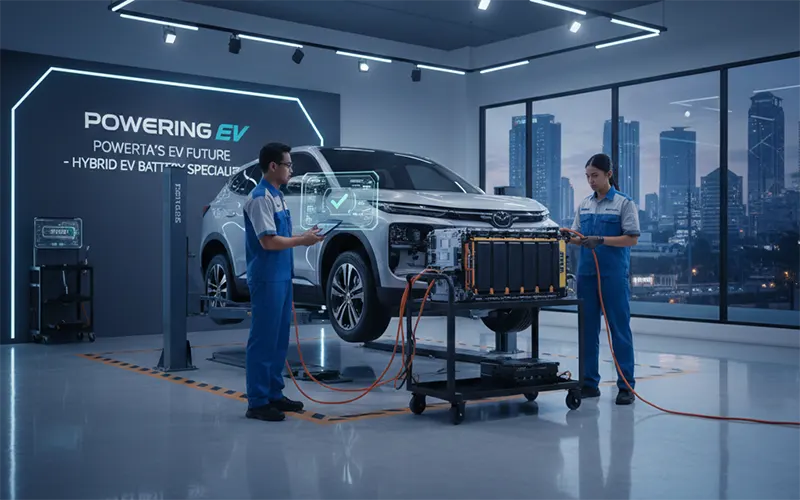
As Jakarta accelerates its transition toward a greener horizon in 2026, the local automotive landscape has shifted its focus from the odometer to the “Battery Passport.” With the streets of the capital now populated by a diverse fleet ranging from the ubiquitous Toyota Kijang Innova Zenix HEV to the high-performance BYD Seal, the “Health Check” has become the most critical maintenance ritual for Indonesian vehicle owners.
In a city defined by extreme tropical humidity and grueling stop-and-go traffic, the certified dealership service is no longer just a recommendation—it is the gatekeeper of your vehicle’s performance and future resale value.
1. The Jakarta Context: Why “Battery Health” is the New “Mileage”
Jakarta presents a unique set of challenges for lithium-ion and nickel-metal hydride (NiMH) batteries. The relentless 32°C average temperature, combined with hours spent idling in Sudirman or Gatot Subroto traffic, creates a high-heat environment that can accelerate chemical degradation.
In 2026, a vehicle’s mileage is no longer the primary indicator of value. Instead, the market looks at the State of Health (SoH). A car with 50,000 km but a 96% SoH is valued significantly higher than a 30,000 km car with an 88% SoH. Because of this, the “Battery Health Certificate” issued by an authorized dealership (Bengkel Resmi) has become a mandatory document for any successful trade-in or private sale in the Jabodetabek area.
2. Inside the “Hybrid & EV Health Check”
When you bring your vehicle to a certified dealer—such as Auto2000, Hyundai Gowa, or a BYD authorized center—the diagnostic process is far more rigorous than a standard oil-change inspection. It involves three core pillars:
A. Diagnostic Trouble Code (DTC) Scanning
Technicians use proprietary manufacturer software to communicate with the Battery Management System (BMS). Unlike generic OBD-II scanners, these tools can identify “silent” anomalies in the balancing of cells or minor faults in the high-voltage isolation system before they trigger a dashboard warning light.
B. Internal Resistance & Voltage Analysis
The health of a battery is determined by how easily electricity can flow through its cells. Dealers measure:
- Tegangan (Voltage) Balance: Ensuring all cell modules are discharging at the same rate.
- Internal Resistance: Detecting “hot spots” within the battery pack that indicate aging or potential failure.
C. Visual & Thermal Inspection
Jakarta’s dust and monsoon floods can wreak havoc on cooling systems. Technicians manually inspect the battery cooling fans, vents, and high-voltage cabling for corrosion or debris. A clogged filter in a Toyota hybrid, for instance, can lead to overheating that permanently lowers the battery’s lifespan.
3. The Dealer Advantage: Specialized Expertise
While independent repair shops are common in Jakarta, the complexity of EV architectures in 2026 has widened the gap between “official” and “general” service.
- Certified Technicians: Dealerships now employ “High-Voltage Safety Technicians” who are specifically licensed under Indonesian safety regulations to handle 400V–800V systems.
- Software Synchronization: Many modern EVs require firmware updates during a health check to optimize the charging curve based on local climate data—updates often unavailable to independent shops.
- Cost Transparency: A standard battery health check in Jakarta currently ranges from Rp100,000 to Rp300,000, though many manufacturers (like Toyota) offer this for free during regular service intervals for cars aged 3 to 5 years.
4. Protecting the 8-Year Warranty
Most manufacturers in Indonesia, including Hyundai and Wuling, offer an 8-year/160,000 km battery warranty. However, this warranty is often contingent on “Regular Certified Maintenance.”
By obtaining a 6-month State of Health Certificate, owners create a documented “paper trail” of care. If a battery’s capacity drops below the typical 70% threshold during the warranty period, having a complete history of dealership health checks ensures a seamless, no-cost replacement. Without this, proving that the degradation wasn’t caused by “misuse” (such as frequent deep discharges in Jakarta heat) can be difficult.
5. Summary: The Battery Health Certificate
The output of a certified service is the Battery Passport. Here is what a standard 2026 certificate includes:
| Component | Description | Why it Matters |
| State of Health (SoH) | Percentage of original capacity remaining | Primary factor for resale value |
| Cycle Count | Number of full charge/discharge cycles | Indicates the “age” of the battery’s chemistry |
| Cell Delta V | Voltage difference between strongest and weakest cell | Detects failing modules early |
| Thermal History | Record of any overheating incidents | Proves the battery was operated safely |
The Future: Resale Transparency
Looking toward 2027, the Indonesian government and independent labs are working to integrate these battery certificates into a national database. This will allow used-car buyers in Jakarta to scan a QR code on a vehicle’s windshield and instantly see its certified battery history.
For now, the best way to protect your investment is to stick to the Bengkel Resmi. In the humid, high-traffic reality of Jakarta, a certified health check is the only way to ensure your “blue-plate” vehicle stays on the road for years to come.