
Implementing Cellular V2X Communication for Real-Time Traffic Optimization in Smart City Grids
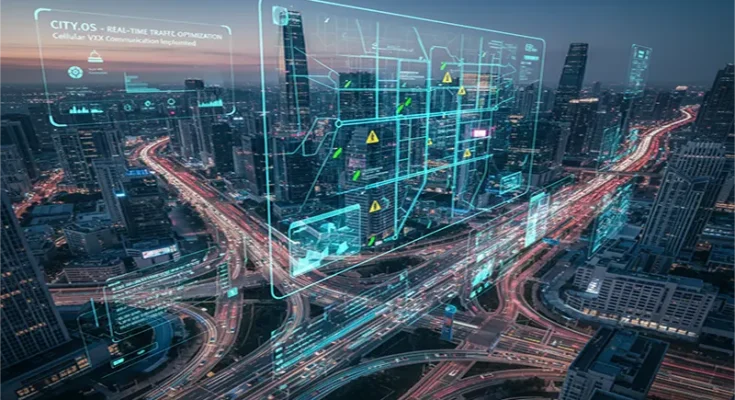
The dream of a “frictionless” city—where traffic jams are relics of the past and emergency vehicles glide through green lights without slowing—is no longer a science-fiction trope. In 2026, the global rollout of Cellular Vehicle-to-Everything (C-V2X) has transformed urban infrastructure into a living, digital nervous system. By shifting from a model of reactive driving to one of Cooperative Orchestration, smart city grids are now capable of optimizing traffic flow in real-time with millisecond precision.
Implementing this at scale requires a deep integration of 5G-Advanced standards, edge computing, and a fundamental shift in how we perceive vehicle data.
1. The Architecture of Connectivity: PC5 vs. Uu Interfaces
C-V2X is unique because it operates on a dual-mode communication architecture, standardized by 3GPP Release 18 (5G-Advanced). To optimize a city grid, both “lanes” of communication must be utilized:
- The PC5 (Sidelink) Interface: This is the “short-range” direct communication mode. It operates