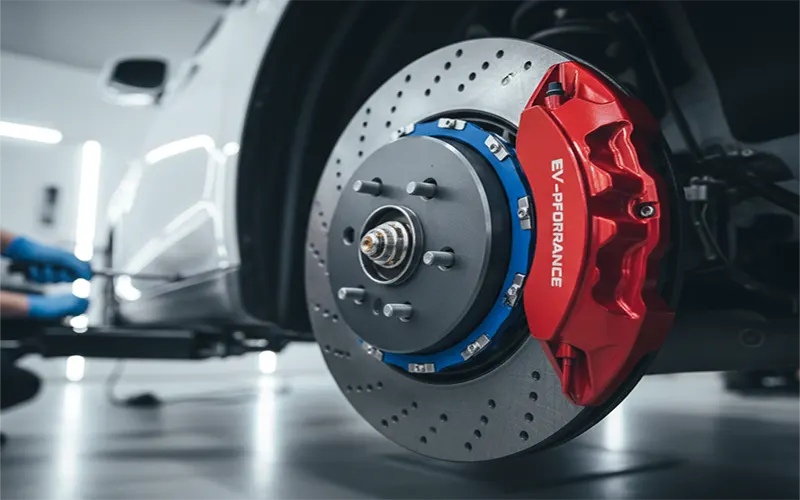
In the world of internal combustion engines (ICE), brake wear is a matter of friction. In the world of electric vehicles (EVs), brake failure is a matter of chemistry. As we enter 2026, a growing number of first-generation EV owners are facing a “Corrosion Paradox”: their brake pads have 90% of their life remaining, yet the entire system must be replaced because the rotors are pitted with rust and the pads are delaminating from their backing plates.
Because regenerative braking handles the vast majority of deceleration, the physical friction brakes often sit cold and idle. This lack of heat allows moisture and road salt to linger, turning your braking system into a breeding ground for oxidation. To prevent this, EV owners need to move beyond “standard” parts and look toward specialized, corrosion-resistant technologies.
1. The Regenerative Paradox: Why EV Brakes Fail Early
In a traditional car, every stop generates enough heat (often exceeding 200°C) to instantly evaporate moisture and “scrub” the thin layer of oxidation (flash rust) that forms on rotors overnight.
In an EV, you might drive for weeks without ever truly engaging the calipers. This leads to two specific failure modes:
- Pitting and Scaling: Moisture sits on the cast iron, creating deep pits. When you finally do need to emergency brake, the surface is uneven, leading to vibration and reduced stopping power.
- Rust-Jacking: Moisture seeps between the friction material and the steel backing plate of the pad. As the steel rusts, it expands, literally “jacking” the brake material off the plate until it cracks or falls off entirely.
2. Rotor Technology: FNC vs. Specialized Coatings
To fight rotor rust, the industry has moved toward two primary solutions: surface transformation and high-performance coatings.
Ferritic Nitrocarburizing (FNC)
FNC is not a coating; it is a thermochemical process that diffuses nitrogen and carbon into the surface of the iron. This creates a hard, dark-grey “case” that is significantly more resistant to corrosion than raw iron.
Why it’s great for EVs: Tesla, GM, and several European manufacturers now use FNC rotors as standard equipment. They can survive salt spray tests for over 100 hours without showing signs of oxidation.
Tungsten Carbide and Hard-Metal Coatings
At the premium end, we see solutions like the Bosch iDisc or Porsche’s PSCB. These rotors are laser-clad with a layer of Tungsten Carbide.
- Pros: They produce 90% less brake dust and stay mirror-shiny for the life of the car.
- Cons: They are prohibitively expensive for most “commuter” EVs, often costing 3-4 times more than a standard rotor.
Technical Comparison of Rotor Types
| Feature | Standard Cast Iron | FNC Treated | Tungsten Carbide (iDisc) |
| Rust Resistance | Low (hours) | High (months) | Absolute (years) |
| Brake Dust | Moderate/High | Moderate | Ultra-Low |
| Cost | $ | $$ | $$$$ |
| Lifespan | 3-5 years (in salt) | 8-10 years | Lifetime of vehicle |
3. Low-Dust & Galvanized Pads: The Second Line of Defense
For an EV, the backing plate of the brake pad is just as important as the friction material itself.
The Case for Galvanized Pads
Standard brake pads are painted. Once that paint chips, rust begins to grow. NRS Brakes has pioneered the use of Galvanized (zinc-plated) steel backing plates for EVs. Zinc acts as a sacrificial anode; even if scratched, the zinc corrodes instead of the steel, preventing rust-jacking.
Furthermore, look for Mechanical Attachment (NRS Hooks). Instead of relying on glue—which can be compromised by moisture—these pads feature hundreds of tiny steel hooks that physically lock the friction material to the plate.
Low-Dust Ceramic Compounds
EV wheels are often designed for aerodynamics, meaning they have large, flat surfaces that show brake dust immediately. A Ceramic or Non-Asbestos Organic (NAO) compound is essential. These pads don’t just keep the wheels clean; they operate quietly, which is vital in a car with no engine noise to mask brake squeal.
4. Top Product Recommendations for 2026
The “Best Overall” Kit: Brembo Beyond EV
Brembo’s Beyond EV Kit is the first total solution designed specifically for the EV duty cycle. It features a specialized coating on the rotors and a dedicated “EV” pad with a blue galvanized backing plate. It is engineered to maintain high friction even when the brakes are cold—a common scenario for regenerative drivers.
The “Durability” Choice: NRS-EV + PowerStop EV35
If you live in the “Salt Belt,” pair NRS Galvanized Pads with PowerStop EV35 coated rotors. The EV35 rotors use a proprietary “Geomet” coating that covers the entire surface, including the internal cooling vanes, to prevent internal “rot” from the inside out.
The “Silent” Choice: Akebono Euro/Ultra-Premium
For those who prioritize the “library-quiet” cabin of a luxury EV like a Lucid or BMW i7, Akebono’s ceramic formulations are the gold standard for Noise, Vibration, and Harshness (NVH) control.
5. The Maintenance Hack: The “Cleaning” Cycle
Even with the best hardware, physical maintenance is required. Once a week, you should perform a Brake Bedding or “Cleaning” cycle:
- Find a safe, empty road.
- Accelerate to 50 mph.
- Shift the car into Neutral (this usually disables regenerative braking).
- Apply firm, consistent pressure to the brakes until you reach 10 mph.
- Repeat 2–3 times.
This generates enough heat to cook off moisture and ensures that the “transfer film” of the pad remains evenly distributed across the rotor surface.