

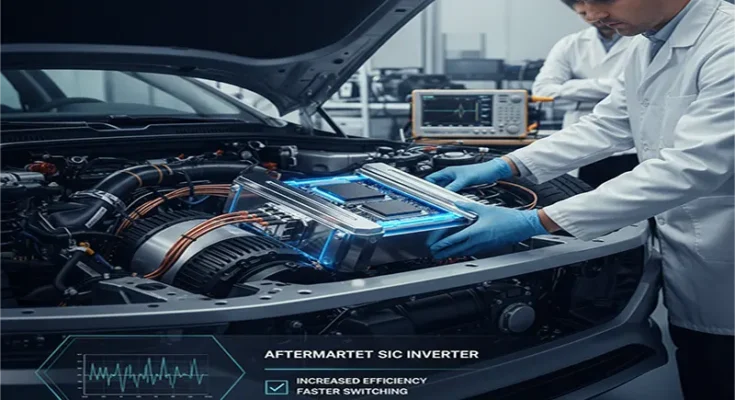
The Semiconductor Revolution: Upgrading to Aftermarket Silicon Carbide (SiC) Inverter Modules
In the early years of the electric vehicle transition, performance was a product of software limits and battery cell discharge rates. However, as we enter 2026, the enthusiast community has identified a new mechanical ceiling: the silicon-based inverter. For owners of aging 400V platforms (2018–2022) or those building custom high-output drivetrains, the transition to Silicon Carbide (SiC) MOSFET-based inverters is the equivalent of a “turbo swap” for the digital age.
By replacing traditional Silicon (Si) Insulated-Gate Bipolar Transistors (IGBTs) with SiC power modules, tuners are unlocking higher efficiencies, reduced thermal bottlenecks, and a significant expansion of the motor’s usable power band.
1. Beyond the IGBT Limit: The Wide Bandgap Advantage
For decades, the standard for power conversion has been the Silicon IGBT. While robust, these transistors suffer from a fundamental physical limitation: switching losses. Because silicon has a relatively narrow bandgap, it requires significant energy to “turn on” and …
The Semiconductor Revolution: Upgrading to Aftermarket Silicon Carbide (SiC) Inverter Modules Read More