
As the automotive world settles into 2026, the initial “gold rush” of the electric vehicle transition has matured into a robust used market. For buyers and sellers alike, the most critical metric is no longer 0–60 mph times or software Easter eggs; it is residual value.
Three years ago, in 2023, the Hyundai Ioniq 6 and the Ford Mustang Mach-E were two of the most sought-after non-Tesla EVs on the market. Now, with those three-year leases ending and vehicles hitting the second-hand market, we have a clear picture of which brand’s strategy held water—and which one was submerged by depreciation.
1. The State of the Market: MSRP vs. Reality
The 2023 model year was a chaotic starting point for this comparison. It was the year of the “Tesla Price Wars,” where aggressive cuts by Elon Musk forced both Ford and Hyundai to slash MSRPs mid-cycle.
In 2026, we see that the Mustang Mach-E suffered from “High-Entry Volatility.” Many 2023 buyers paid dealer markups or high initial MSRPs before Ford aggressively cut prices in 2024 and 2025 to move inventory. Conversely, the Ioniq 6 entered the market with a more stable, albeit higher, pricing structure. This distinction is vital: depreciation is measured from the original price paid, and those who bought the Mach-E at its 2023 peak have felt the sharpest sting.
2. Hyundai Ioniq 6: The Efficiency Hedge
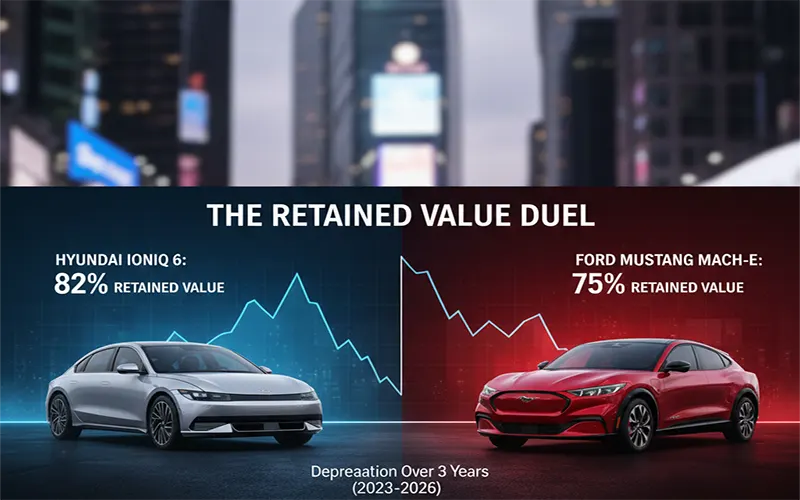
By 2026, the Hyundai Ioniq 6 has established itself as the “Efficiency King” of the used market. Its three-year residual value has remained surprisingly resilient, currently hovering around 50–52% of its original MSRP.
The 800V Advantage
The primary factor keeping the Ioniq 6’s value high is its 800-volt charging architecture. While many 2023 EVs are now considered “slow” by 2026 standards, the Ioniq 6 can still charge from 10% to 80% in 18 minutes. In a used market where “charging anxiety” has replaced “range anxiety,” this technological future-proofing has acted as a financial safety net.
Furthermore, the Ioniq 6’s ultra-low drag coefficient ($0.21$) means it extracts more miles per kWh than almost any other vehicle in its class. In 2026, as electricity prices have seen moderate increases, the Ioniq 6’s “miles-per-dollar” efficiency makes it a top choice for used buyers.
3. Mustang Mach-E: The Supply Surge and SUV Fatigue
The Ford Mustang Mach-E, while a triumph of branding and design, has faced a steeper climb. Its three-year residual value in 2026 sits closer to 44–48%.
The Supply-Demand Seesaw
Ford’s massive ramp-up in production during 2023 and 2024 led to a surplus of inventory by early 2025. This “inventory glut” forced Ford to offer deep incentives on new models, which effectively lowered the price ceiling for used Mach-Es.
Technologically, the Mach-E’s 400-volt architecture is starting to show its age in 2026. While a respectable performer, its 30-to-45-minute fast-charging times are now viewed as a mid-tier compromise compared to the newer E-GMP (Hyundai/Kia) or NACS-native (Tesla) platforms. However, the Mach-E’s utility as a crossover still keeps it in high demand for families, preventing its value from cratering completely.
4. Factor Comparison: Sedan vs. SUV
Traditionally, SUVs hold their value better than sedans. However, the 2023–2026 cycle has seen a slight reversal of this trend in the EV space.
- Range as Currency: The 2023 Ioniq 6 Long Range offered up to 361 miles of range. In 2026, a used EV with over 350 miles of range is a rare and valuable commodity.
- Utility vs. Tech: The Mach-E offers a “frunk” and a hatchback, which used buyers love. But the Ioniq 6 offers V2L (Vehicle-to-Load) capabilities, allowing owners to power home appliances. In 2026, “car-as-a-battery” utility has become a major selling point that has helped the Hyundai sedan keep pace with the Ford SUV.
5. The “Tax Credit Floor”
Perhaps the most interesting phenomenon in 2026 is the “Used EV Credit Floor.” Because the federal used EV tax credit applies only to vehicles sold for $25,000 or less, we are seeing a massive cluster of 2023 Mach-Es and Ioniq 6s priced exactly at $24,999.
This has effectively halted depreciation for many of these cars. If a car’s “natural” market value is $26,000, it is often better for a dealer to price it at $24,999 so the buyer can get the $4,000 credit, making the net price $20,999. This has created a price “plateau” that has stabilized values for both models.
2026 Depreciation Snapshot (3-Year Average)
| Metric | 2023 Hyundai Ioniq 6 (LR) | 2023 Mustang Mach-E (Premium) |
| Original MSRP (2023) | ~$45,500 | ~$50,900 |
| Typical 2026 Resale | ~$23,600 | ~$22,900 |
| 3-Year Retained Value | ~52% | ~45% |
| Primary Value Driver | 800V Fast Charging | SUV Utility / Brand Name |
Which is the Smarter Buy?
In 2026, the Hyundai Ioniq 6 is the “winner” of the depreciation battle, largely due to its superior charging technology and the fact that Hyundai didn’t oversupply the market as aggressively as Ford.
However, for the used buyer, the Mustang Mach-E is arguably the better value. Because it depreciated faster from a higher starting price, you can now pick up a premium Ford SUV for the same price as a Hyundai sedan, despite the Ford having a more “premium” interior and more versatile cargo space.