As the first generation of mass-market electric vehicles—such as the early Tesla Model S, BMW i3, and Chevrolet Volt—surpasses the decade mark, the focus of the secondary market is shifting. While much of the public discourse centers on battery cell degradation, independent technicians and “Right to Repair” advocates are discovering a different reality: the supporting thermal infrastructure often fails long before the lithium-ion cells do.
In these aging packs, two critical failure points emerge: the mechanical fatigue of High-Voltage (HV) coolant pumps and the chemical breakdown of Thermal Interface Materials (TIM). If left unaddressed, these issues lead to localized hot spots, accelerated capacity loss, and eventually, catastrophic thermal runaway.
1. The Silent Killers of Old Packs: Pump Fatigue and TIM Degradation
In the EV world, thermal management is the primary determinant of longevity. While an internal combustion engine’s cooling system primarily prevents the warping of metal, an EV’s cooling system manages delicate chemical stabilities.
Thermal Interface Material (TIM)—often referred to as “thermal paste” or “gap filler”—serves as the bridge between the battery modules and the liquid-cooled “chiller” plates. Over ten years, this material can undergo “pump-out” (migration due to thermal expansion) or “dry-out” (loss of volatile components), which increases thermal impedance.
Simultaneously, HV coolant pumps are subject to thousands of hours of duty cycles. Unlike 12V auxiliary pumps, these units are often integrated into the high-voltage bus to achieve the necessary torque for high-flow rates. Over time, bearing wear or impeller cavitation reduces the flow rate, meaning that even if the pump is “running,” it isn’t moving enough volume to maintain thermal equilibrium across the pack.
2. Diagnostics: Monitoring Delta-T and Flow Telemetry
Identifying a failing thermal system requires more than just checking for a “Check EV System” light. Technicians must utilize CAN-bus diagnostic tools to monitor Delta-T ($\Delta T$), the temperature variance between the hottest and coldest cells.
$$\Delta T = T_{max} – T_{min}$$
In a healthy 400V pack, $\Delta T$ should remain within $3^{\circ}\text{C}$ to $5^{\circ}\text{C}$ during standard operation. A widening gap—especially during DC fast charging—is a hallmark of degraded TIM or localized flow restriction. Furthermore, by logging the Pump Speed (RPM) vs. the Flow Rate (L/min), a technician can identify “slippage” or air ingress. If the pump is spinning at maximum duty cycle but the temperature is not dropping, the thermal bridge has likely failed.
3. High-Voltage Coolant Pump Replacement
Replacing an HV pump is a high-stakes procedure that begins with strict safety protocols.
Isolation and Safety
Before any mechanical work, the vehicle must be put into an Electrically Safe Work Condition (ESWC). This involves:
- Removing the Manual Service Disconnect (MSD) or isolating the pyrotechnic fuse.
- Verifying Zero Volts: Using a CAT III or CAT IV multimeter to ensure the HV bus has discharged (typically below 60V DC).
The Replacement Process
Once isolated, the pump—often located near the front drive unit or integrated into the pack penthouse—is disconnected from its high-voltage harness. When installing the new unit, the critical step is not the bolt-up, but the Vacuum Refill.
EV cooling loops are complex and cannot be “burped” like a 20th-century radiator. Air pockets in a battery pack are essentially insulators; a cell surrounded by air while others are surrounded by coolant will overheat rapidly. A vacuum-fill tool is used to evacuate the system to roughly $-25 \text{ inHg}$ before drawing in fresh coolant, ensuring a 100% liquid-to-surface contact.
4. The TIM Refresh: Materials and Methods
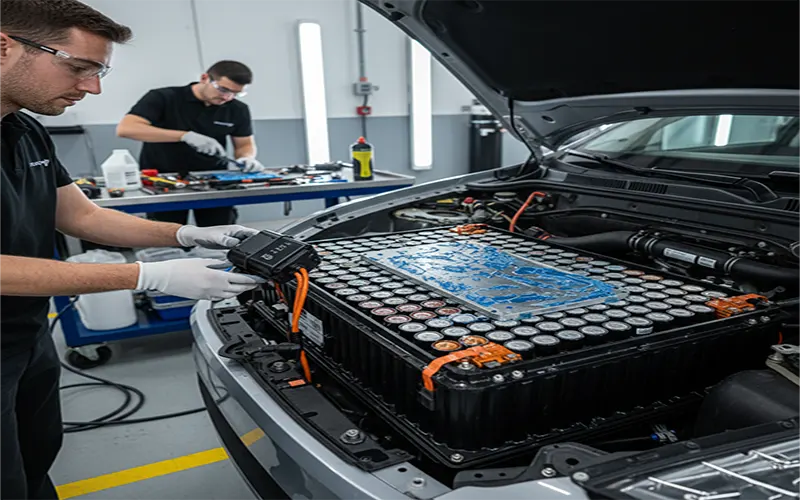
“Dropping the lid” on a battery pack to refresh the TIM is the most labor-intensive preventative measure, but it is the only way to restore “like-new” thermal performance.
Step-by-Step Refurbishment:
- Cleaning: After removing the battery modules, the old TIM—which may have turned into a brittle, chalky substance—must be removed. This requires non-conductive, plastic-safe solvents and lint-free wipes.
- Material Selection: Modern replacements usually involve Two-Part Thermally Conductive Potting Compounds or Gap-Filling Gels. These materials are chosen for their high thermal conductivity ($k \approx 2.0 \text{ to } 4.0 \text{ W/m}\cdot\text{K}$) and their “self-leveling” properties.
- Application: The compound must be applied in a precise pattern to ensure that when the module is bolted down, the material spreads outward, pushing all air ahead of it. Any trapped air bubble creates a “thermal bottleneck” that Fourier’s Law of Heat Conduction predicts will cause a spike in localized temperature.
5. Case Study: Active vs. Passive Systems
The difference this maintenance makes is best seen in the contrast between the Tesla Model S (Liquid-Cooled) and the Nissan Leaf (Passive Air-Cooled).
While the Leaf’s pack simply degrades as its internal chemistry “cooks” in high-heat environments, the Tesla’s liquid system allows for surgical intervention. By replacing a $400 pump and refreshing the thermal pads, an owner can effectively “reset” the thermal aging clock of the pack, potentially doubling the remaining useful life of the cells.
6. Safety & Environmental Risks
Working with high-voltage systems carries a risk of lethal shock, and the coolants themselves—often a 50/50 mix of deionized water and ethylene glycol or specialized dielectric fluids—must be handled as hazardous waste. Dielectric coolants, while safer for the electronics in the event of a leak, have different viscosity profiles that may require specific pump calibrations.
As the “Right to Repair” movement grows, the ability to service the thermal support systems of an EV pack will become as routine as a timing belt change was for the previous generation. By addressing HV pumps and TIM today, we ensure that the EVs of yesterday remain on the road tomorrow.