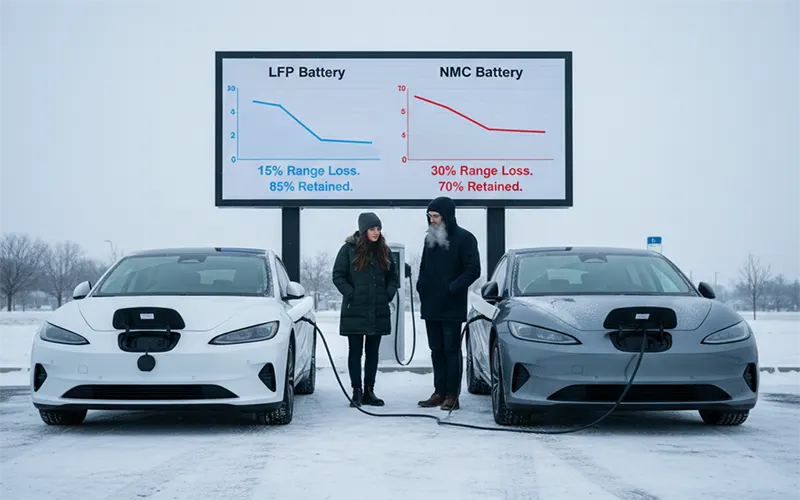
By early 2026, the “great battery split” of 2024 has become a major talking point in the pre-owned market. If you are shopping for a two-year-old EV today, you aren’t just choosing between brands; you are choosing between chemistries. The 2024 model year saw a massive surge in Lithium Iron Phosphate (LFP) batteries in entry-level trims (like the Tesla Model 3 RWD) and Nickel Manganese Cobalt (NMC) in long-range variants.
As these cars face their second or third winter, real-world telemetry has revealed a stark contrast in how they handle the “Big Freeze.”
1. The Chemistry of Cold: Why Ions Slow Down
At a molecular level, temperature is simply a measure of kinetic energy. When the mercury drops below $0^{\circ}\text{C}$, the electrolyte inside a battery becomes more viscous—essentially “thicker”—making it harder for lithium ions to move between the anode and cathode.
- LFP’s Struggle: LFP batteries use an olivine crystal structure. While incredibly stable and long-lasting, this structure has lower inherent conductivity. In sub-freezing temps, internal resistance in an LFP cell increases nearly 3x more than in an NMC cell.
- NMC’s Resilience: NMC (and its cousin NCA) uses a layered oxide structure that allows for higher ion mobility even as the fluid thickens. This is why a 2024 Model 3 Long Range (NMC) typically feels “snappier” in January than the RWD (LFP) version.
2. LFP in the Wild: The “Voltage Cliff” and Range Hits
Data from the winter of 2025–2026 has confirmed what early testers suspected: 2024 LFP-equipped EVs are highly sensitive to “cold-soaking.”
If a 2024 Tesla Model 3 RWD is left outside overnight in $-10^{\circ}\text{C}$ weather, owners typically report a 25% to 35% drop in usable range. However, the most frustrating part of LFP winter ownership is the “Voltage Cliff.” Because LFP has a very flat discharge curve, the Battery Management System (BMS) struggles to calculate the exact State of Charge (SOC) when the battery is cold. This can lead to “phantom” range drops, where the car might show 15% and suddenly drop to 5% as the ions “wake up” and the BMS recalibrates.
2026 Market Note: Used LFP models are currently selling for $2,000–$3,000 less in northern states like Minnesota compared to sun-belt states like Arizona due to this winter “reputation.”
3. NMC: The Cold Weather Workhorse
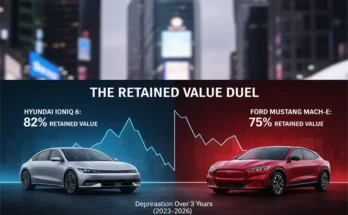
For those in the “Salt Belt,” the 2024 NMC-based EVs (such as the Hyundai IONIQ 6 or the Extended Range Mach-E) have proven to be the superior winter companions.
While NMC batteries still lose range—primarily due to cabin heating—their chemical “floor” is higher. In identical $-10^{\circ}\text{C}$ conditions, an NMC pack typically sees a 15% to 20% range hit. Crucially, NMC packs reach their optimal operating temperature significantly faster than LFP packs. Because NMC is more energy-dense, it generates more internal heat during discharge, which creates a positive feedback loop that helps the battery “self-thaw” during a drive.
4. The Heat Pump Equalizer
It’s important to note that by 2024, most major EVs (Tesla, Hyundai, Kia) included heat pumps as standard equipment. This has been a massive equalizer. A 2024 LFP model with a heat pump often outperforms a 2021 NMC model without one.
The heat pump reduces the energy “tax” required to keep the cabin at $21^{\circ}\text{C}$, allowing more of the battery’s limited winter capacity to be used for propulsion. Without a heat pump, range loss in either chemistry can easily balloon toward 45%.
5. Charging in the Tundra: The Fast-Charge Gap
The real “deal-breaker” for LFP in winter isn’t driving—it’s charging.
- LFP: If you pull into a Supercharger with a cold-soaked LFP battery, you may see speeds as low as 15 kW (about the speed of a dryer outlet). LFP requires preconditioning. If the car hasn’t been “pre-heating” for 30 minutes before arrival, your 20-minute stop can turn into 90 minutes.
- NMC: NMC batteries are far more “forgiving.” While they still slow down, an NMC pack will often accept 50–80 kW even when moderately cold, as the chemistry can handle the higher voltage stress of a cold-charge better than LFP.
Real-World Winter Range Comparison (At $-5^{\circ}\text{C}$)
| 2024 Model (Used) | Chemistry | EPA Range (New) | Winter Range (2026 Data) | % Loss |
| Model 3 RWD | LFP | 272 Mi | 185 Mi | -32% |
| Model 3 Long Range | NMC | 341 Mi | 279 Mi | -18% |
| IONIQ 6 (RWD) | NMC | 361 Mi | 296 Mi | -18% |
| BYD Atto 3 / Seal | LFP | 310 Mi | 210 Mi | -32% |
6. The 2026 Buyer’s Verdict
Winter range loss is temporary seasonal degradation, not permanent capacity loss. However, it changes how you use the car.
- Buy LFP if: You have a garage for overnight charging, a daily commute under 100 miles, and you live in a climate where it rarely stays below freezing for weeks at a time. The longevity and 100% daily charge limit make LFP a superior long-term value.
- Buy NMC if: You park outside, live in a truly cold climate (Canada, Northern US, Scandinavia), or frequently road-trip in the winter. The predictable SOC and faster cold-charging are worth the premium price.