As we stand at the threshold of 2027, the automotive world is no longer just talking about the “battery of the future”—it is beginning to drive it. While traditional liquid-electrolyte lithium-ion (Li-ion) batteries have been the faithful workhorses of the first EV wave, a new contender has reached commercial maturity: the All-Solid-State Battery (ASSB).
For 2027 EV models, the comparison between these two technologies is not merely academic; it represents the difference between a vehicle that “manages” range and one that “eliminates” range anxiety.
1. The Energy Density Leap: Beyond 500 Wh/kg
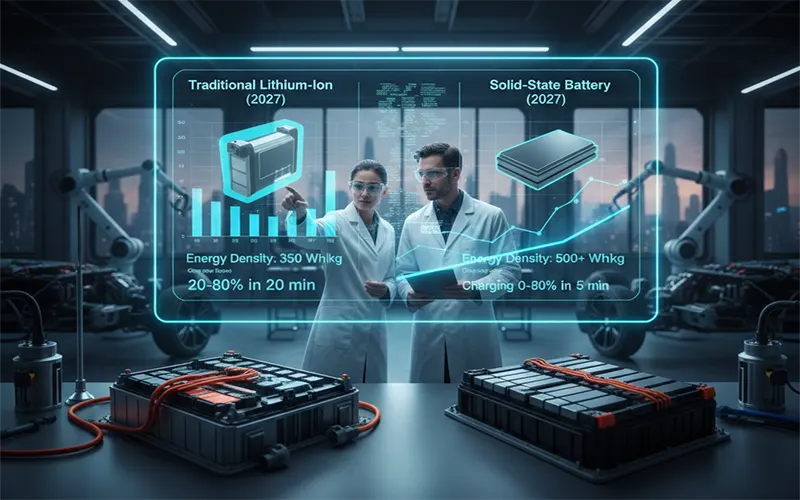
In the world of batteries, energy density is the ultimate metric for portable power. Traditional lithium-ion cells, which use a liquid electrolyte and a graphite-based anode, are currently approaching their physical ceiling of approximately 250–300 Wh/kg.
By contrast, 2027 solid-state models are shattering this limit. By replacing the flammable liquid electrolyte with a solid ceramic or sulfide-based separator, engineers have finally unlocked the use of Pure Lithium Metal Anodes. Lithium metal has a significantly higher theoretical capacity than graphite, allowing 2027 solid-state cells to achieve energy densities between 450 and 500 Wh/kg.
Impact on 2027 Models:
- The 1,000 km Club: High-end models from Toyota and Lexus are debuting with ranges exceeding 1,200 km on a single charge.
- Weight Efficiency: Alternatively, for mass-market cars, solid-state allows manufacturers to halve the weight of the battery pack while maintaining a standard 500 km range, drastically improving vehicle handling and efficiency.
2. Charging Speed Revolution: 0-80% in Under 10 Minutes
Charging speed is the second frontier where solid-state technology claims dominance. Traditional Li-ion batteries suffer from a phenomenon called Lithium Plating or Dendrite Formation—microscopic spikes of lithium that grow during fast charging and can puncture the separator, causing fires.
Solid electrolytes are mechanically rigid, effectively acting as a physical shield against dendrites. Furthermore, 2027 sulfide-based solid electrolytes offer superior ionic conductivity.
- Li-ion (2027): Even the best “5C” fast-charging Li-ion batteries take roughly 18–25 minutes to reach 80% charge.
- Solid-State (2027): Flagship models can now achieve a 10-minute 0-80% charge time. This brings the EV “refueling” experience into parity with a traditional gasoline station stop, effectively removing the primary psychological barrier to EV adoption.
3. Safety and Longevity Advantage: The Non-Flammable Future
The “Solid” in solid-state refers to the electrolyte, which is typically a non-flammable ceramic or sulfide. This removes the risk of Thermal Runaway, a catastrophic chain reaction where a liquid electrolyte catches fire if punctured or overheated.
Beyond safety, the 2027 ASSB offers a vastly superior Cycle Life. Because solid electrolytes are less prone to the “side reactions” that degrade liquid cells, these batteries are projected to last over 15 years or 1,000,000 kilometers with less than 10% degradation.
| Parameter | Lithium-Ion (2027 High-End) | Solid-State (2027 Flagship) |
| Energy Density | 250 – 300 Wh/kg | 450 – 500 Wh/kg |
| 0-80% Charge Time | 20 – 30 minutes | 10 – 12 minutes |
| Max Typical Range | 600 – 800 km | 1,000 – 1,200 km |
| Fire Risk | Low (with safety systems) | Near Zero (Inherent) |
| Operating Temp | -20°C to 60°C | -30°C to 100°C |
4. Remaining Hurdles: The “Giga” Challenge
While the physics of solid-state batteries are superior, the 2027 landscape still faces significant industrialization hurdles.
- Stack Pressure: Solid-state cells require high physical pressure to maintain contact between the solid layers. Engineering battery packs that can maintain this “squeeze” over years of road vibration is a complex mechanical challenge.
- Manufacturing Costs: As of early 2026, solid-state production remains roughly 8x more expensive than Li-ion per kWh. This is why the first 2027 solid-state models (like the Lexus flagship and BYD’s Yangwang sub-brand) are positioned as luxury items.
- Supply Chain: Scaling the production of high-purity Lithium Sulfide is the new bottleneck, replacing the cobalt/nickel concerns of previous years.
5. Market Outlook: Who Leads in 2027?
The 2027 model year will be remembered as the “Phase 1” of solid-state commercialization.
- Toyota: Having received official production approval in late 2025, Toyota is the clear leader, with its first “All-Solid-State” BEV expected to roll off Japanese lines in early 2027.
- The Chinese Giants: BYD and CATL have confirmed limited production of sulfide-based cells for 2027, focusing on high-end luxury SUVs where the price premium can be absorbed.
- The US Contenders: QuantumScape and Solid Power are shipping “B-Samples” to partners like Volkswagen and BMW, aiming for small-batch commercial integration by late 2027.
Key Takeaways
- Density: Solid-state offers nearly double the range for the same physical weight as Li-ion.
- Charging: We have finally reached the 10-minute charge milestone, making long-distance EV travel identical to ICE travel.
- Target Market: For 2027, expect solid-state to be a “premium-only” feature, with mass-market parity likely not arriving until 2030–2032.