
Comparing Solid-State Battery Energy Density and Charging Speeds vs. Traditional Lithium-Ion for 2027 EV Models
As we stand at the threshold of 2027, the automotive world is no longer just talking about the “battery of the future”—it is beginning to drive it. While traditional liquid-electrolyte lithium-ion (Li-ion) batteries have been the faithful workhorses of the first EV wave, a new contender has reached commercial maturity: the All-Solid-State Battery (ASSB).
For 2027 EV models, the comparison between these two technologies is not merely academic; it represents the difference between a vehicle that “manages” range and one that “eliminates” range anxiety.
1. The Energy Density Leap: Beyond 500 Wh/kg
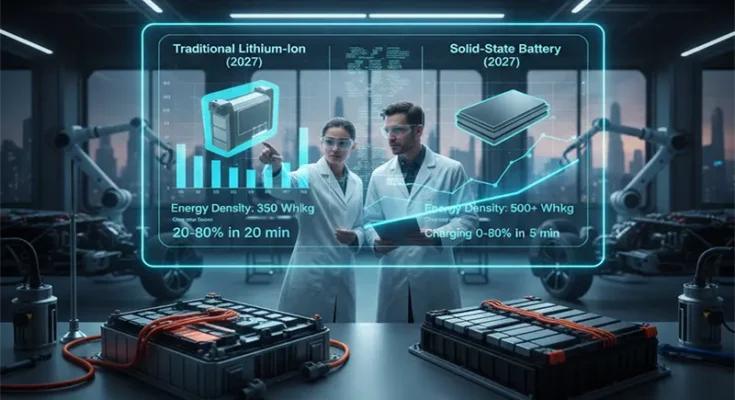
In the world of batteries, energy density is the ultimate metric for portable power. Traditional lithium-ion cells, which use a liquid electrolyte and a graphite-based anode, are currently approaching their physical ceiling of approximately 250–300 Wh/kg.
By contrast, 2027 solid-state models are shattering this limit. By replacing the flammable liquid electrolyte with a solid ceramic or …
Comparing Solid-State Battery Energy Density and Charging Speeds vs. Traditional Lithium-Ion for 2027 EV Models Read More