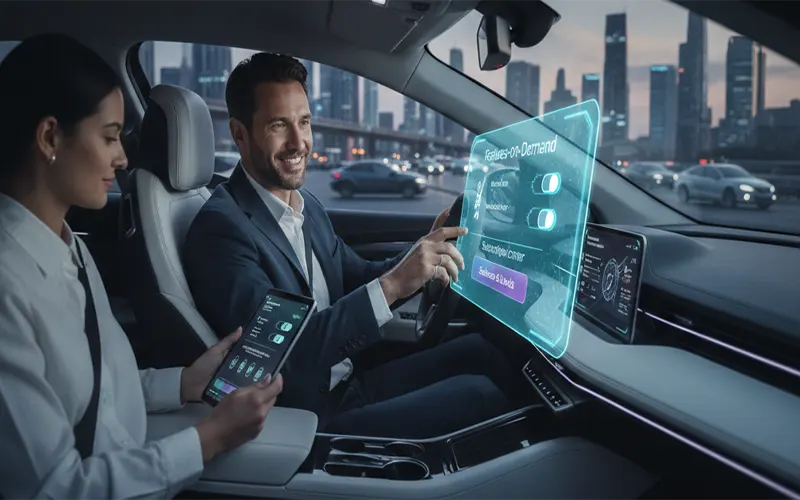
The automotive industry is undergoing its most significant structural change since the introduction of the assembly line. We are moving away from the era of “Horsepower and Chrome” toward an era of “Bits and Bytes.” By 2026, the car is no longer just a mechanical product; it is a Software-Defined Vehicle (SDV)—a programmable, evolving platform that serves as a mobile data center.
For Original Equipment Manufacturers (OEMs), this shift isn’t just about technology; it’s about a fundamental transformation of their business models. The SDV enables a “Features-on-Demand” (FoD) strategy that turns a one-time vehicle sale into a multi-year, high-margin subscription relationship.
1. The Architectural Shift: From ECUs to Zonal Computing
Traditional vehicle architecture was a “patchwork” of up to 150 separate Electronic Control Units (ECUs), each dedicated to a single function like power windows or engine timing. This distributed model made it nearly impossible to update the car’s software holistically.
The modern SDV utilizes a Zonal Architecture. In this setup, several High-Performance Computers (HPCs) act as central brains, connected to “zonal gateways” that manage specific physical areas of the car. This creates a Hardware Abstraction Layer, where the software is decoupled from the physical components.
This centralization allows OEMs to run virtualized environments. Much like a laptop can run multiple apps, a single vehicle HPC can simultaneously manage safety-critical braking systems and a high-end infotainment experience, allowing for individual “services” to be updated or added without touching the underlying hardware.
2. Enabling Features-on-Demand (FoD)
In the SDV era, cars are frequently shipped “hardware-complete but software-limited.” This means the physical sensors, heaters, or processors are already installed in the factory, but they remain dormant until a customer chooses to “digitally unlock” them.
Mechanics of Digital Unlocking:
- Performance Boosts: An OEM can offer a “Ludicrous Mode” or increased horsepower via a software update that re-maps the electric motor’s torque curves.
- Convenience Features: A driver might realize they want heated steering or advanced matrix LED headlights six months after purchase. A quick transaction in the vehicle’s app store activates the feature instantly.
- Safety & ADAS: Advanced Driver Assistance Systems (like Level 3 “hands-off” driving) can be offered as a trial, allowing users to experience the tech before committing to a purchase.
3. The Subscription Economy and Recurring Revenue
The financial incentive for this shift is staggering. Traditional vehicle sales offer thin margins, often between 5% and 10%. In contrast, software-based services operate with margins of 70% to 90%.
By 2026, OEMs are projecting that Average Revenue Per User (ARPU) will be a more important metric than total units sold. Tiered subscription models are becoming the industry standard:
| Subscription Tier | Example Features | Revenue Type |
| Connectivity | 5G Hotspot, Live Maps, Music Streaming | Monthly/Annual |
| Performance | Faster 0-60mph, Adaptive Suspension | One-time / Seasonal |
| Autonomy | Highway Pilot, Remote Valet Parking | Monthly / Pay-per-use |
4. The Data Feedback Loop and Digital Twins
SDV platforms rely on a “Digital Twin”—a virtual replica of the vehicle in the cloud that mirrors its real-world status. Through constant telemetry, OEMs can monitor usage patterns to offer personalized upgrades.
If the vehicle’s sensors detect that a driver frequently encounters heavy rain, the infotainment system might suggest a “Safety Lighting Upgrade.” If the GPS sees the car is at a race track, it could offer a 24-hour “Track Mode” subscription. This data-driven sales approach ensures that FoD offerings are relevant to the driver’s immediate needs, increasing conversion rates.
5. Challenges: Consumer Backlash and Technical Debt
The transition has not been without friction. As we head into 2026, “Subscription Fatigue” is a real threat. High-profile pushback against paying monthly fees for hardware already present in the car (like heated seats) has forced OEMs to be more strategic.
The Hurdles:
- Fairness Perception: Consumers are wary of “pay-to-play” for basic comforts. OEMs are pivoting toward value-add services (like advanced AI assistants or autonomy) rather than basic hardware unlocks.
- Cybersecurity: A connected fleet is a target. The 2026 industry standard requires Zero-Trust Security and end-to-end encryption for all OTA (Over-the-Air) updates.
- Regulation: New privacy laws now mandate that drivers have “right-to-delete” their biometric and location data, which complicates the personalized marketing loop.
Key Takeaways
- Zonal Architecture is the technical enabler, turning cars into manageable “computers on wheels.”
- Recurring Revenue from software services provides a vital buffer against the flattening growth of physical car sales.
- The Digital Twin allows for predictive maintenance and highly targeted “In-Vehicle Commerce.”
- Brand Loyalty in 2026 is driven by the quality of the software experience, not just the mechanical reliability.