
For decades, the California car-buying experience was often defined by the “teaser price”—a low number featured on a windshield that inevitably ballooned once the customer reached the finance office. However, as of October 1, 2026, the Golden State has officially entered a new era of automotive retail.
With the implementation of the California Combating Auto Retail Scams (CARS) Act (SB 766), the landscape has shifted from “buyer beware” to “dealer disclose.” This 1,000-word feature explores how real-time transparency and verified customer data are reshaping the way Californians buy cars.
1. The 2026 Shift: California’s New Era of Transparency
The catalyst for this change is the CARS Act, which codifies “best-in-class” protections for consumers. The hallmark of the law is the Mandatory Total Price Disclosure. In 2026, California dealers are legally prohibited from advertising a price that does not include all mandatory dealer-installed accessories and add-ons.
Under SB 766, the “Total Price” must be clearly and conspicuously disclosed in:
- All Advertisements: Whether on social media, third-party sites like Edmunds, or the dealer’s own homepage.
- The First Communication: The very first time a salesperson texts or emails you about a specific VIN, they must provide the total price.
- Prohibited Junk Fees: Dealers can no longer charge for “valueless” add-ons, such as nitrogen-filled tires with less than 95% purity or oil change plans for Electric Vehicles (EVs).
2. Verified Delivery Stories: Beyond the Five-Star Review
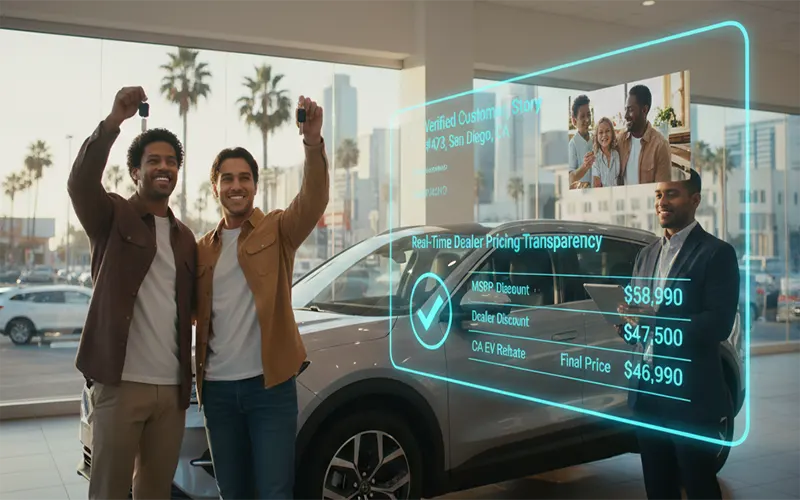
In this new transparent market, “Verified Delivery Stories” have replaced vague Yelp reviews. These stories are data-integrated testimonials that prove a dealership is actually honoring the CARS Act.
“I saw a 2024 RAV4 Hybrid listed for $36,500 online. In the past, I would have expected a $2,000 ‘protection package’ to be added at the desk. But because of the new law, the quote I got in my first text was the final price I signed. The ‘Verified Delivery’ badge on the site gave me the confidence to drive from Irvine to Van Nuys because I knew the numbers wouldn’t move.” — Sarah M., Verified Buyer, November 2026
A Verified Customer Story in 2026 typically includes:
- Price Match Verification: Confirmation that the final OTD (Out-the-Door) price matched the initial digital quote.
- Time-to-Complete: Tracking how long the physical delivery took (now averaging under 60 minutes due to pre-negotiated transparency).
- Add-on Transparency: Documentation that the customer was explicitly told that items like GAP insurance were optional.
3. The Tech Behind the Transparency: Real-Time Desking
The “Single Source of Truth” is the technological backbone of the 2026 California dealership. Using Desking Intelligence, dealers now sync their online inventory with their in-store Dealer Management Systems (DMS) in real-time.
This prevents the “Bait-and-Switch” tactics of the past. If a vehicle’s price is updated on a smartphone app at 10:00 AM, that exact price is automatically reflected on the F&I (Finance and Insurance) manager’s tablet at 10:01 AM. Dealers are now required to maintain these records for two years to demonstrate compliance, making “pricing errors” a legal liability rather than a simple mistake.
4. Consumer Protections: The 3-Day Right to Cancel
Perhaps the most significant change for used car buyers is the Cooling-Off Period. California is the first state to mandate a 3-day right to cancel for used vehicles under $50,000.
| Feature | Pre-2026 Standard | 2026 CARS Act Standard |
| Advertised Price | Often excluded “mandatory” add-ons | Must include all dealer-added items |
| Add-on Disclosure | Often buried in the fine print | Must be disclosed as optional in writing |
| Used Car Returns | Final sale (unless a fee was paid) | Mandatory 3-day right to cancel (<$50k) |
| Record Retention | Varying dealer policies | Strict 2-year retention of all quotes |
How the 3-Day Rule Works:
- Eligibility: Applies to used vehicles priced at $50,000 or less.
- Conditions: The car must be returned within 3 business days, have fewer than 400 miles added, and be undamaged.
- Restocking Fees: Dealers can charge a fee (1.5% of the price, capped at $600) but must refund the rest of the purchase price.
5. Negotiation Checklist for the 2026 Buyer
Even with new laws, savvy buyers should follow this checklist to ensure they are getting the full benefit of California’s transparency:
- [ ] The “First Written” Quote: Ensure your first email or text contains the Total Price.
- [ ] Identify “Valueless” Items: If you see a charge for “theft-deterrent etching” that doesn’t actually lower your insurance, point to SB 766’s ban on valueless add-ons.
- [ ] Review the Itemized Disclosure: Every add-on must have a separate line showing its cost and the fact that it is optional.
- [ ] Exercise the 10-Day Window: Under the CARS Act, you now have up to 10 days to decide on optional service contracts rather than being forced to choose at the moment of signing.
The 2026 California car market is no longer a battlefield of hidden fees; it is a marketplace of verified data. Between the CARS Act‘s strict transparency mandates and the rise of Verified Delivery Stories, the power has shifted back to the consumer. For the first time, “Real-Time Pricing” in California actually means what it says.